BluPaper #1 Article
Compounding AI Chaos
Why Agencies Are Moving From the Multi-Tech Stack to an Agency Web Ecosystem
10 min read
The Chaos and Cost Live in the Gaps
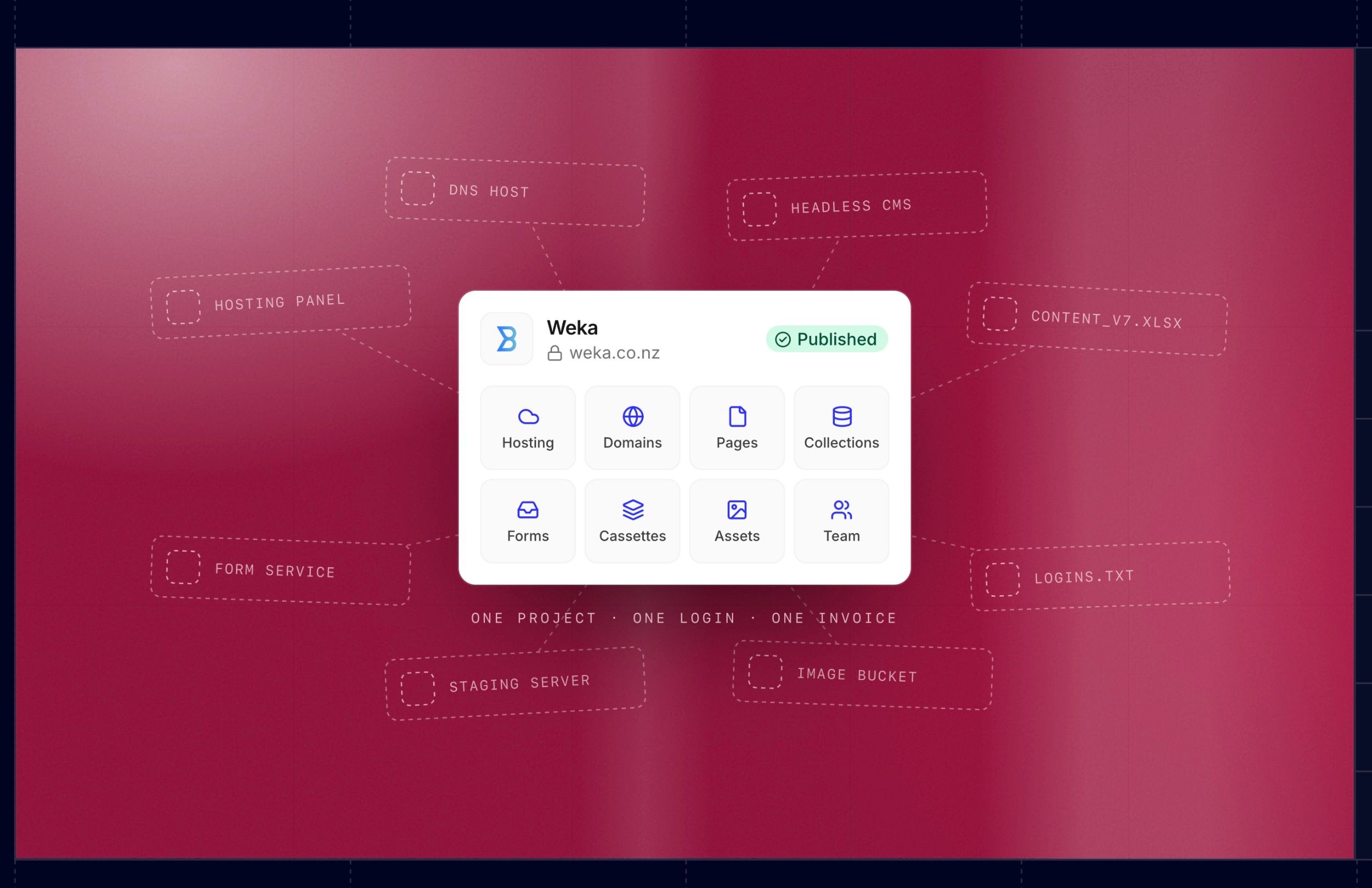
Agencies are losing time, margin and creative energy to web technology that was never built around them. A typical website now runs on a patchwork of separate tools for code, hosting, infrastructure, content and, increasingly, AI. Each tool is capable. The cost lives in the gaps between them.
Those gaps are paid for in hours: setup, integration, maintenance, vendor management and firefighting. They are hours spent on technology rather than client value, and they come straight out of the agency's bottom line.
AI is accelerating the problem. Bolt-on AI tools, platform-owned token pricing and client vibe-coding are adding a new layer of fragmentation, which we call AI spaghetti, on top of a stack that was already tangled.
The Blutui® Agency Web Ecosystem (AWE) is a different model. It brings development, hosting, infrastructure, content management and AI together in one white-label ecosystem, built by a working agency. Front-end teams keep full control of their code and craft. Clients get safe, structured editing. The agency remains the trusted partner while Blutui powers delivery behind the scenes. This paper sets out the problem, defines the AWE category, and gives agency leaders a practical way to measure what the multi-tech stack is really costing them.
The problem: a stack that eats agency value
The multi-tech stack was not designed; it accumulated. One client needed a particular CMS, another a specific host, a third a headless build. Each decision made sense at the time. Together they created an operating model where every project starts by rebuilding the plumbing.
The question every agency leader should ask is simple: is the tech stack you've invested a fortune in eating your agency from the bottom line up?
Where the cost shows up
Time. Environment setup, integrations, deployments, plugin updates and security patches consume hours on every project, and again across every live site.
Margin. Those hours are rarely fully billable. Separate licences, hosting plans and vendor contracts stack up per client, while fixed-fee projects absorb the overrun.
Talent. Senior developers become system maintainers. Designers and front-end specialists, increasingly the most valuable people on web projects, wait on technical dependencies before they can create.
Risk. Every extra vendor is another point of failure, another login, another security surface and another party to chase when something breaks.
Control. Platform brands sit between the agency and its client. Clients are given broad technical access to make simple content changes, and the agency's craft is exposed to accidental damage.
The compounding effect
None of these costs is dramatic on its own. The damage comes from repetition: the same setup, the same integration and the same maintenance, multiplied across every client and every year. Agencies end up running a technology operation alongside their creative one, without being paid for it.
Eight tools to chase, or one project on Blutui
Why now: AI is amplifying fragmentation
AI is amazing. It can take a prototype to production faster than any team could a few years ago. But dropped into an already fragmented stack, it multiplies the fragmentation rather than solving it.
AI spaghetti. Each tool brings its own AI features, prompts and outputs, with no shared structure or production standard.
Unpredictable costs. Platform-owned models and token pricing put the agency's AI costs in someone else's hands, and those prices can move without warning.
Client vibe-coding. Clients can now generate sites themselves. Without structure, that produces work that is hard to maintain and erodes the agency's role.
The agencies that win the next phase will not be the ones with the most AI tools. They will be the ones that bring AI under control: structured, accountable, cost-predictable, and in service of their own talent. That is the job of an ecosystem, not another point tool.
At a glance
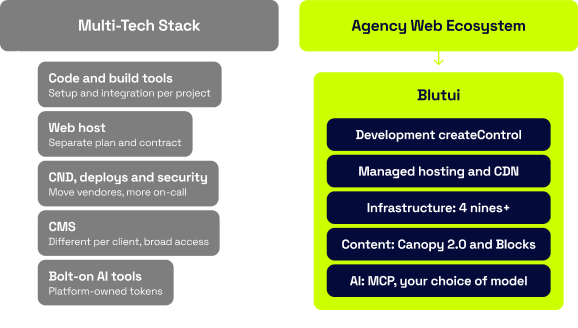
multi-tech stack vs Agency Web Ecosystem
In a multi-tech stack the agency holds every connection itself. In an Agency Web Ecosystem those layers sit inside one white-label environment, and the agency works with one partner.
Defining the Agency Web Ecosystem
Businesses run on category systems: a CRM for customer relationships, an ERP for operations, a CMS for content. Agencies have never had a system built for the way they actually deliver web work. The Agency Web Ecosystem is that category.
An Agency Web Ecosystem is a single, white-label environment that orchestrates everything an agency needs to design, build, host, run and evolve client web experiences, while keeping the agency in control of the client relationship and the craft. It is not a CMS, and it is not a DIY generalist builder. It is an agency ecosystem, never a CMS.
Five principles
Agency-first. Built around agency economics, workflows and client relationships, not adapted from a product made for someone else.
Orchestrated agency value. Development, hosting, infrastructure, content and AI work as one system, so value flows to the agency instead of leaking between tools.
createControl. Front-end developers keep their code, frameworks and creative freedom. The ecosystem handles infrastructure and repetitive production.
Invisible partner. Fully white label. The agency is the trusted partner; the ecosystem powers delivery behind the scenes.
Pro-agency, pro-developer, pro-human. Technology and AI exist to make agency talent go further, not to replace it.
How Blutui works, layer by layer
Blutui is the only Agency Web Ecosystem. It supports microsites, landing pages, corporate websites and data-driven web apps from one environment.
Site development
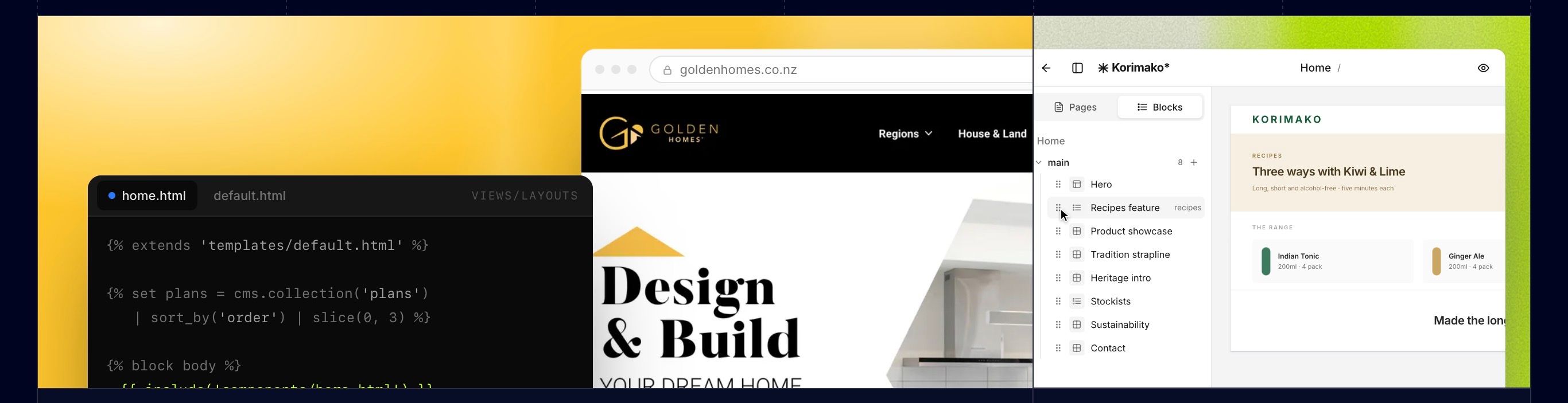
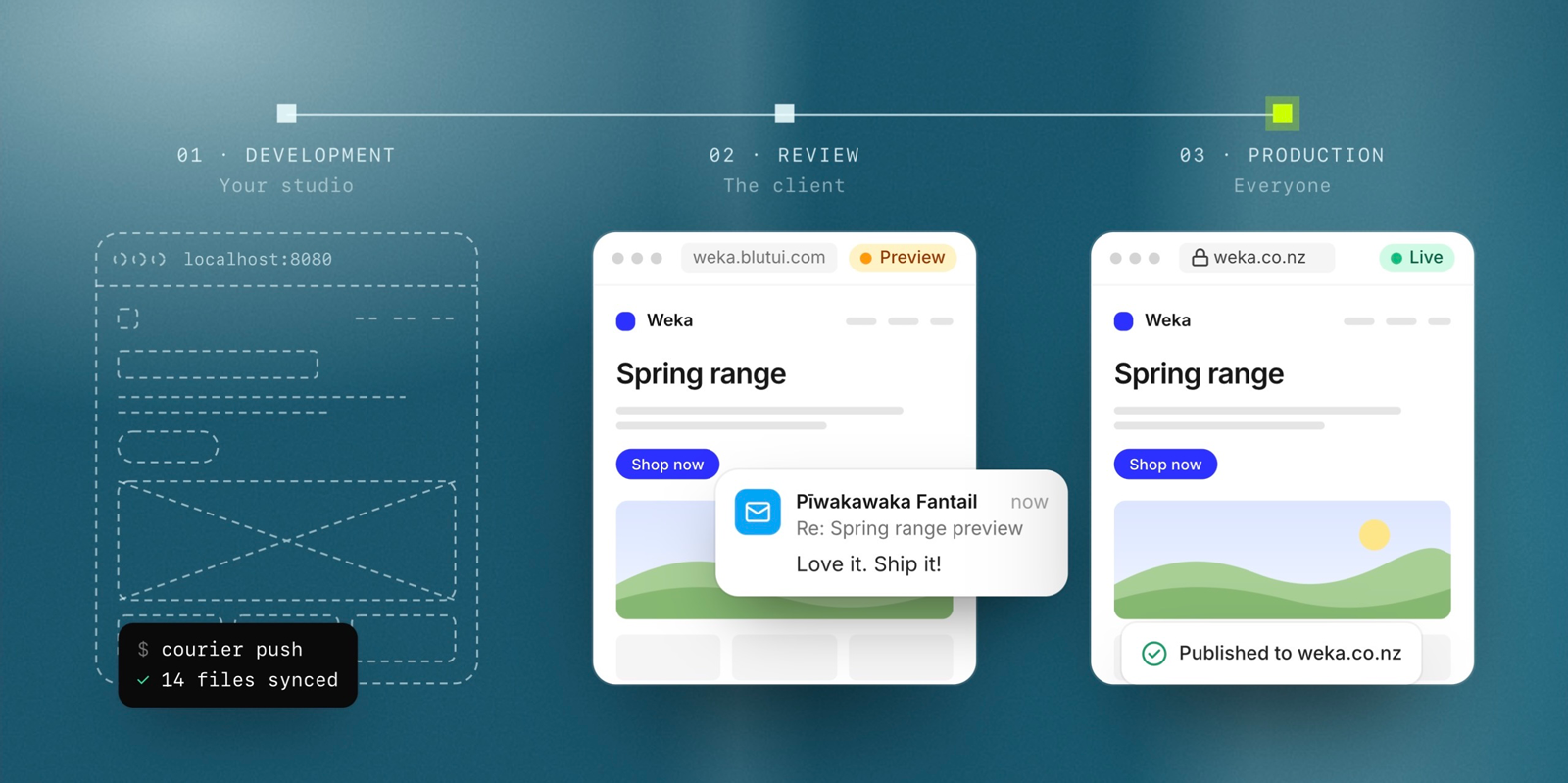
Front-end teams build with the code and frameworks they already know. Initialisation and deployment are automated, and the Courier CLI keeps local workflows fast. Designs can move from any design tool (ie Figma or Paper prototype) to a live site in under three minutes, so creative time is spent on the experience, not the setup.
Developers build in agentic or hand crafted code, and Courier syncs it to Blutui
Hosting
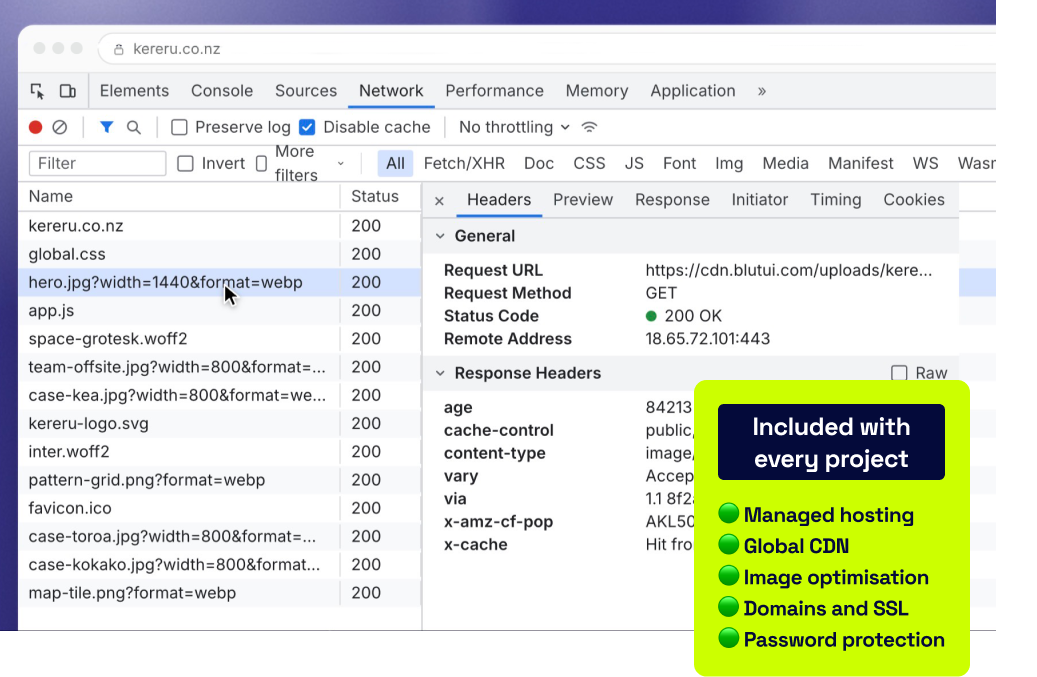
Managed hosting is part of the ecosystem, not a separate contract. CDN, deployment and SEO/AEO foundations come built in, and every site sits under the agency's own brand through agency and project white labelling.
Control Layer
Blutui runs the infrastructure so the agency does not have to. SSO, user management and Open API analytics are included, and the platform has delivered 4 nines+ availability. Continuum adds headless delivery and webhooks for builds that need to connect to other systems.
Hosting, a global CDN, domains and SSL, all handled
Content management
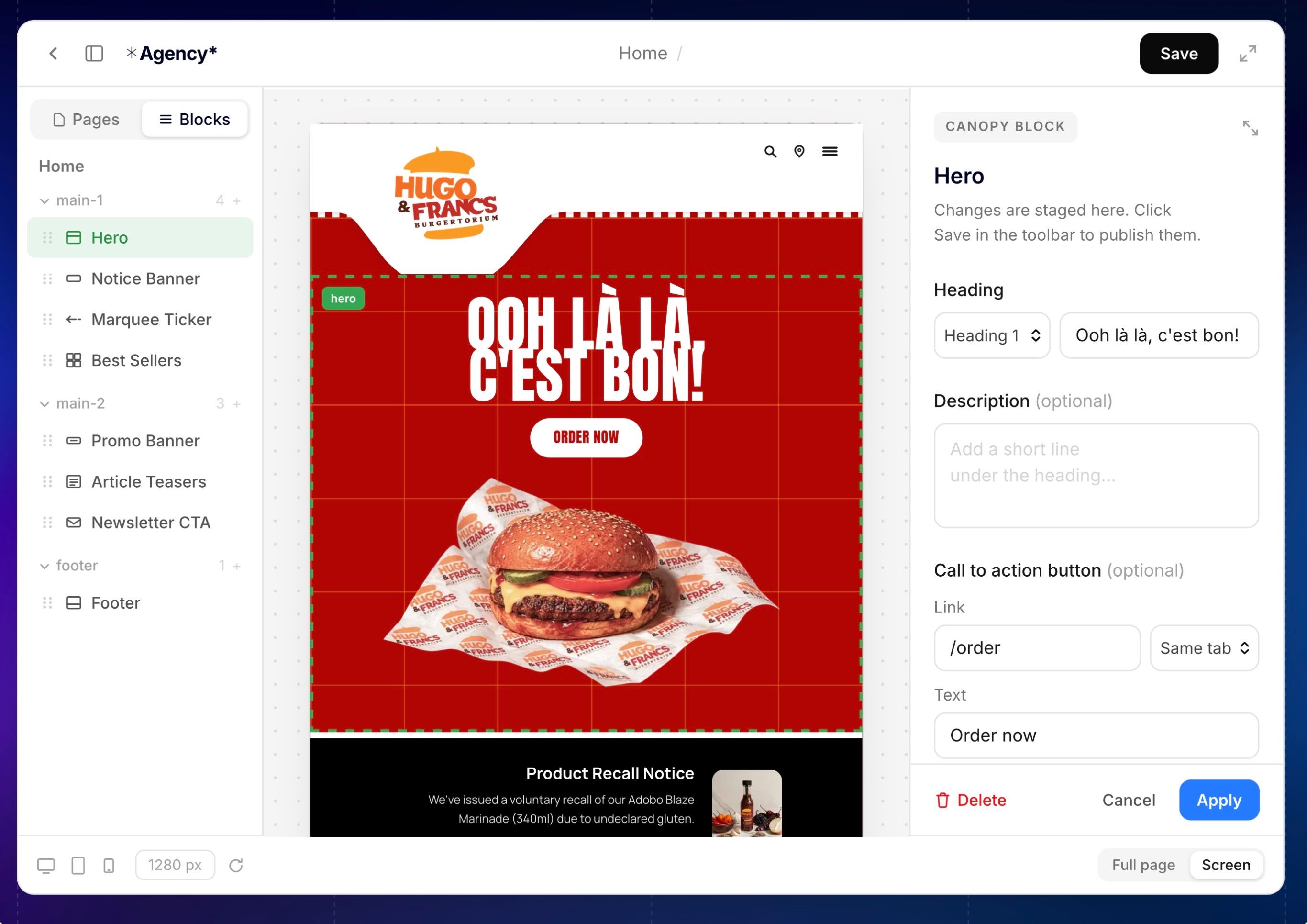
Clients edit content without touching the build. Canopy 2.0 lets them add and reorder sections using custom components with defined fields, and Canopy Blocks give them freedom inside the guardrails the agency sets. Cassettes let one set of production data power campaign sites and multiple front ends, so content is created once and used everywhere.
Client edits the page in Canopy and the design holds
AI
Blutui MCP and Agentic Skills bring AI into production with structure. Agencies connect to the models of their choice rather than a platform-owned token ecosystem, which keeps AI costs predictable. Context and Collections give AI-assisted work a consistent, maintainable shape.
Every project is an API, with tokens, Webhooks, and MCP Context
Side by side
Area | Multi-tech stack | Agency Web Ecosystem |
|---|---|---|
Site development | Setup and integration on every project | Designs can move from any design tool, such as a Figma or Paper prototype, to a live site in under three minutes, so creative time goes into the user experience and client value, not unseen setup. |
Hosting | Separate host, CDN and deployment tools | Managed hosting, CDN and deployment automation included |
Infrastructure | Multiple vendors, monitoring and on-call | One ecosystem, 4 nines+ availability |
Content management | Different CMS per client, uncontrolled access | Canopy 2.0 and Blocks: clients edit safely within agency guardrails |
AI | Bolt-on tools, platform-owned tokens | MCP and Agentic Skills with your choice of model |
Client relationship | Platform brands sit between agency and client | Fully white label; agency stays the trusted partner |
Agency economics | Margin lost to tech overhead and admin | Up to 97% of production bottlenecks removed; up to 4x productivity |
The economics: take your production process apart
The clearest case for an Agency Web Ecosystem is your own numbers. Take a recent web project apart and examine every hour spent on technology rather than client value. Most agencies are surprised by what they find.
A five-step self-audit
List every tool. Write down each piece of technology a typical project touches: code hosting, build tools, CMS, web host, CDN, forms, analytics, security, AI tools.
Count the hours. For one recent project, estimate the hours spent on setup, integration, deployment, updates and troubleshooting, separately from design, build and client work.
Check the bills. Add up licences, hosting plans and per-site fees across your client portfolio, including the ones absorbed into fixed fees.
Follow the people. Note how much senior developer time goes on maintenance, and how often designers or front-end specialists are blocked waiting on technical work.
Map the risk. Count the vendors you would need to contact if a client site went down tonight, how many people in the agency would know who to ring, and how many clients have technical access they do not need.
Reading the result
The total of steps 2 and 3 is the technology overhead your agency carries. In a multi-tech model it repeats on every project and every year. In an Agency Web Ecosystem most of it is absorbed by the ecosystem, and those hours return to billable creative work, faster delivery and client growth.
Performance in practice
Measure | Blutui result |
|---|---|
Availability | 4 nines+ (99.99%+), with about 17 minutes of planned maintenance downtime in 17 months |
Prototype to live | 2 minutes 44 seconds from design tool to live site in a recorded example, excluding prompt time |
Production bottlenecks | Up to 97% removed |
Productivity | Up to 4x |
These results come from removing work, not from asking teams to work faster. When setup, deployment and infrastructure disappear from the project plan, the same team delivers more, with fewer things that can go wrong.
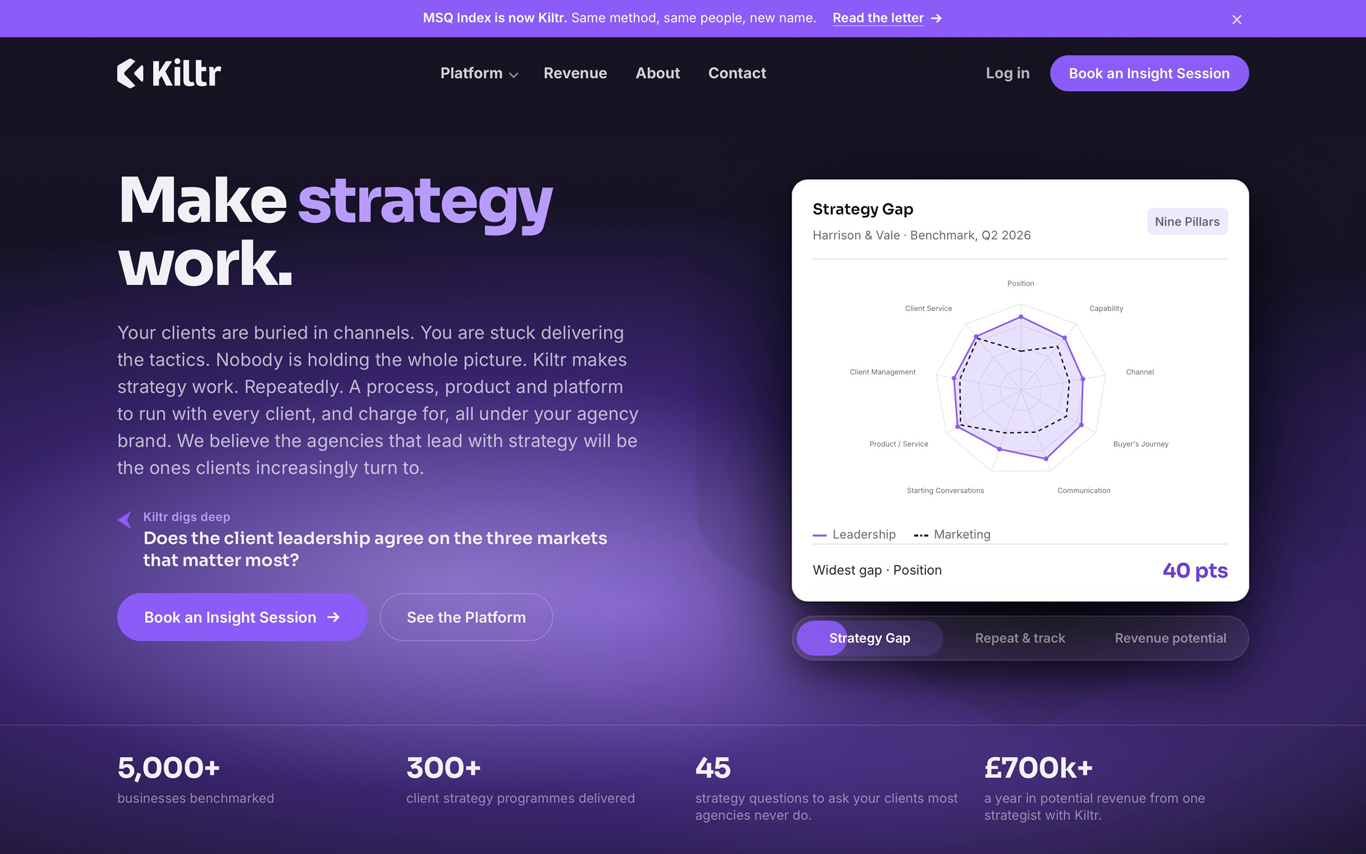
Case study: John Smith Agency and Kiltr
John Smith Agency in Brisbane used Blutui to get the Kiltr website designed and published quickly, working hand in hand with the client's own technology lead.
Agency | John Smith Agency, Brisbane |
Agency lead | Dave Watson |
Client | Kiltr |
Client lead | Ben Slater, CTO |
Delivered | Kiltr website, designed and published on Blutui |
The challenge
Kiltr needed a new website live fast, without the usual setup and hand-offs between design, build, hosting and content tools. As CTO, Ben Slater also needed confidence in the technology underneath: reliable hosting, clean code and a platform his team could work with.
The approach
Dave Watson and the John Smith Agency team led the design and build, while Ben collaborated directly on the technical side. Because development, hosting, infrastructure and content all sit in one Blutui project, agency and client worked in the same environment rather than passing work between separate systems. The agency kept full creative and code control, and the client's CTO had clear visibility from first build to launch.
The result
The Kiltr website went from first design to published in a day, with John Smith Agency as the trusted partner throughout, Kiltr CTO overseeing the build and Blutui powering delivery behind the scenes. “Love the onboarding, the simplicity of the setup and the MCP integration makes the build and content management so straightforward”, Ben Slater, Kiltr CTO. “The key is that we are using multiple administration and build paths to suit different people within the organisation, and every single opportunity to execute what we want to has been seamless. We are really only scratching the surface of what is possible, but from a pure accessibility and actionability perspective Blutui is proving to be an exceptional platform from which we can build and scale.”
Case study: Subvert and the BIMA website
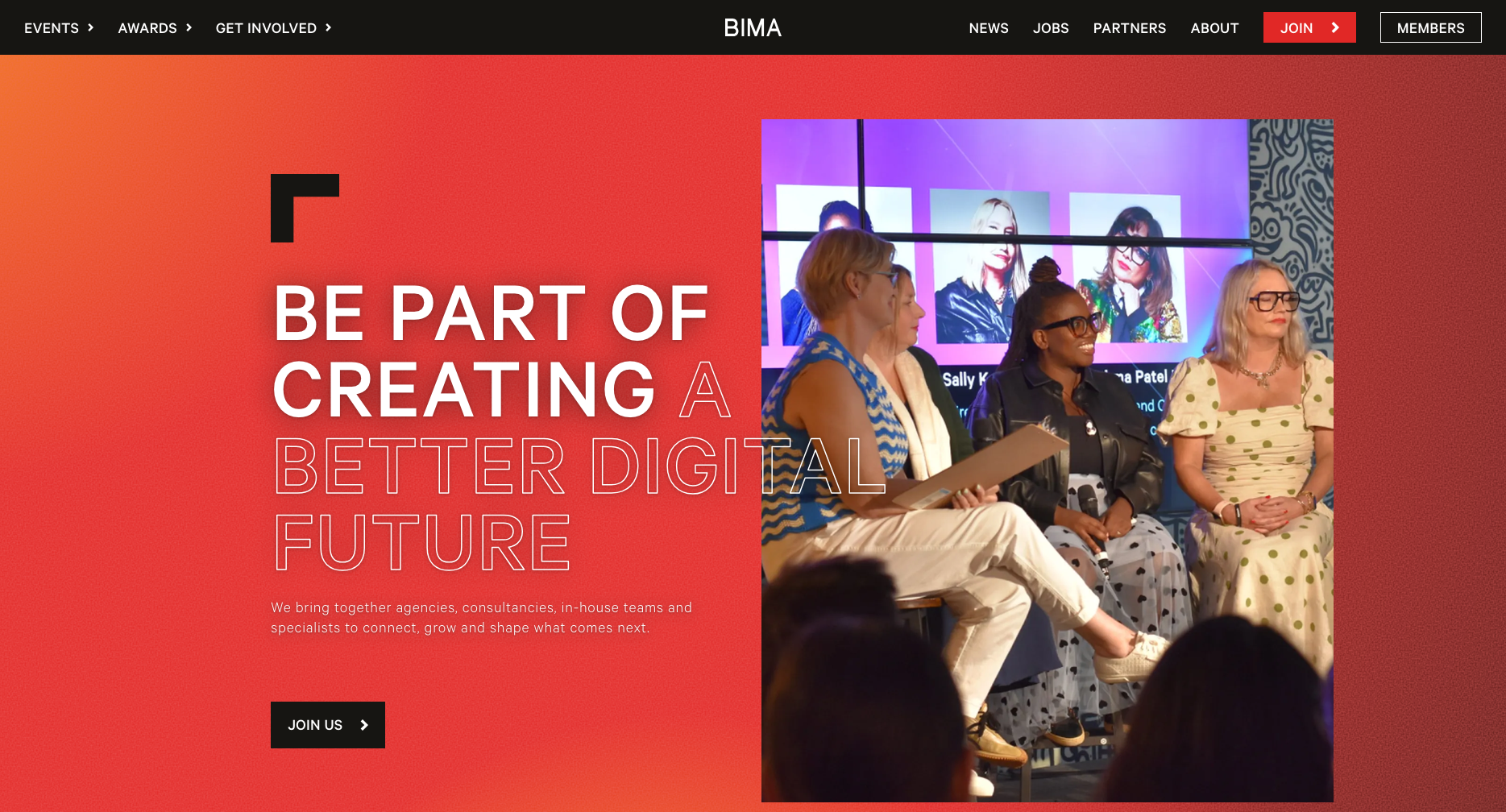
Subvert built the website for BIMA, the UK's digital industry body, on Blutui, and delivered it in about a third of the planned time.
Agency | Subvert, UK |
Agency lead | Ben Perkins, Founder |
Client | BIMA (British Interactive Media Association) |
Delivered | The BIMA website, built and hosted on Blutui |
Build time | About a third of the planned time |
The challenge
BIMA represents the UK's digital and creative industry, so its own website has to be fast, reliable and easy for its team to keep current. Subvert needed to deliver to that standard without the timeline and overhead of a typical multi-tech build.
The approach
Ben Perkins and the Subvert team built the site in code on Blutui, with hosting, infrastructure and content management handled inside the same ecosystem. There was no separate host, CDN or CMS to set up and integrate, so the team's time went into the design and build rather than the plumbing.
The result
The BIMA site was delivered in roughly a third of the time planned and runs on Blutui today. For Subvert, the hours saved on setup and integration went straight back into the work and the margin. For BIMA, it means a site its own team can manage safely.
What changes for each role
Role | In a multi-tech stack | In an Agency Web Ecosystem |
|---|---|---|
Agency leadership | Margin leaks into tooling, vendors and unbilled hours | Predictable costs, more billable capacity, a stronger client position |
Developers and CTOs | Time lost to setup, maintenance and on-call | Full code control, with infrastructure handled |
Design and front-end teams | Creative work waits on technical dependencies | Front-end folk at the core of the agency's growth |
Studio, production and project managers | Many tools to coordinate, many points of failure | One environment, faster launches, fewer surprises |
Clients | Broad technical access, or a ticket for every change | Safe, structured editing and a reliable site |
Making the move
Moving to an Agency Web Ecosystem does not require replacing everything at once. Most agencies start with a single project and expand as the results show.
Book a Fly-Through. A guided walkthrough of Blutui in the context of your agency's own work and clients.
Run the self-audit. Use the five steps above on one recent project to establish your baseline.
Start with one project. A new client site, campaign or landing page is the natural first build.
Measure the difference. Compare hours, costs and launch time against your baseline.
Scale across the portfolio. Bring further clients and projects into the ecosystem as each one renews or launches.
Blutui's commercial model has been redesigned around helping agencies grow rather than charging more as they grow, and the cost of getting an agency onto Blutui has been substantially reduced. See current pricing.
The bottom line
The multi-tech stack makes agencies manage technology. The Agency Web Ecosystem lets technology serve the agency. Blutui makes agency talent go further.
About Blutui
Blutui was born inside an independent agency. Its founders spent decades watching agencies lose time, margin and creative energy to fragmented technology that was never built around them, and set out to build the alternative. Work began in late 2016, the company was established in 2017, and version 1.0 launched in 2022.
Blutui has always been agency-first: agency people at its core, with technologists alongside as equals. Today it is the only Agency Web Ecosystem, a white-label subscription that lets agencies stay the trusted partner while Blutui powers delivery behind the scenes. Learn more at blutui.com.